The History of Sworn Translation in France: From King’s Interpreters to Court Experts
The history of sworn translation in France is closely bound up with the history of justice, diplomacy and the building of the State. Long before the modern term “sworn translator” appeared, the French authorities were already calling on interpreters and translators to ensure that official documents and international exchanges were properly understood.
The origins: ports, diplomacy and royal justice
As early as the Middle Ages, major French ports such as Brest, Marseille and Rouen employed interpreters for trade and maritime exchanges. Under the reign of Francis I, the Ordinance of Villers-Cotterêts of 1539 made French compulsory in the administrative and judicial acts of the kingdom. This decision gradually increased the need for translators able to adapt foreign documents for the royal administration.

In the 17th and 18th centuries, diplomatic relations with the Ottoman Empire, Spain and England encouraged the emergence of genuine language specialists. Some “King’s interpreters” then worked for the navy, the consulates or the commercial courts.
The 19th century: the birth of court expertise
After the French Revolution and the creation of a modern judicial system, the courts had to deal with cases involving foreigners, international contracts or cross-border estates. Judges then began to officially appoint translators to assist the courts.
Under the Second Empire and then the Third Republic, the notion of the “court expert” gradually took shape. Translators were no longer merely occasional auxiliaries: they became specialists recognised by the courts.
One of the founding texts of this organisation is the Act of 29 June 1971 on court experts, which officially structures the modern system of experts attached to the Courts of Appeal. (Wikipedia)
The modern profession: the oath and the Courts of Appeal
The current status of the sworn translator took shape from the 1970s onwards, and was then consolidated by the Decree of 23 December 2004 on court experts. This text sets out the conditions for registration, renewal and the taking of the oath by expert translators and interpreters. (sft.fr)
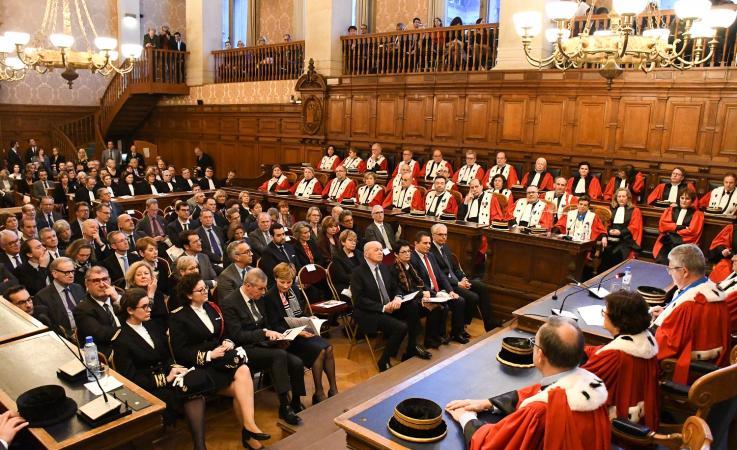
When they are appointed, experts take an oath before the Court of Appeal, using a wording that is still in use today:
“I swear to lend my assistance to Justice…”
This solemn oath makes the translator an officer of the court (cetiecap.com).
Among the judges and lawyers who made a major contribution to the organisation of court experts was Robert Badinter, Minister of Justice from 1981 to 1986, whose reforms modernised the French justice system and strengthened the professionalisation of court experts.
Professional organisations and leading figures
In 1930, the Chambre des Experts-Traducteurs et Traducteurs Assermentés de France was founded; it has become one of the oldest professional organisations in the sector (traducteursdefrance.fr).
In 1986, UNETICA (the National Union of Expert Translators and Interpreters at the Courts of Appeal) was created; it plays a major role in training, defending and structuring the profession (dev.unetica.fr).
More recently, figures such as Natalia Fedossova, President of the Compagnie des Experts Traducteurs et Interprètes près la Cour d’appel de Paris (CETIECAP), have been actively involved in training new court experts and in the development of professional practice. (cetiecap.com)
The Société française des traducteurs (SFT) also helps to define the role of the expert translator more clearly, particularly in the face of the growing number of digital platforms and machine translations (sft.fr).
A profession at the heart of globalisation
Since the 1990s, the growth in migration, university exchanges and international trade has profoundly transformed the profession. Sworn translators now work in a wide range of fields: immigration, family law, international trade, medicine, notarial matters and European procedures.
In Finistère, this trend is particularly visible in Brest, an international port and university city, where the need for certified translations concerns foreign students as much as maritime activities and economic exchanges.
Even today, despite the move to online administrative procedures and the rise of machine translation tools, sworn translation still rests on an age-old principle: the trust that the justice system places in a professional who has sworn an oath of accuracy and impartiality.