Apostille: a Simplified Mechanism for Authenticating Official Documents
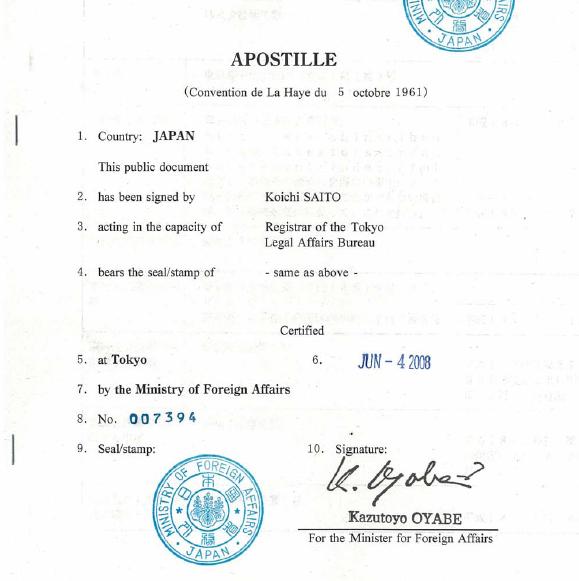
When a French official document needs to be presented abroad, one key question almost always arises: how can its authenticity be guaranteed? To address this issue, the Hague Convention of 5 October 1961, also known as the Apostille Convention, established a simple and universally recognized mechanism: the apostille.
What is an apostille?
An apostille is an official certification that confirms the authenticity of the signature, the capacity in which the person signing the document has acted, and, where appropriate, the identity of the seal or stamp affixed to a public document.
It does not validate the content of the document, but solely its formal authenticity. In practice, it takes the form of a stamp or an additional page attached to the document, bearing the heading “Apostille – Convention de La Haye du 5 octobre 1961.”
In France, the apostille regime is governed by Decree No. 2007-1205 of 10 August 2007 on apostille and legalization, which implements the 1961 Convention. The apostille replaces the lengthy and complex process of diplomatic or consular legalization.
Which documents can be apostilled?
The apostille applies to public documents within the meaning of the Convention, including:
- civil status records (birth, marriage, and death certificates);
- judicial decisions (judgments, rulings);
- notarial acts;
- diplomas issued by public institutions;
- certain administrative documents (certificates, extracts from criminal records, etc.).
By contrast, documents drawn up by private individuals or of a commercial nature (such as invoices) do not fall within the scope of the apostille and require other forms of certification.
Which authority is competent in France?
Since the 2007 reform, French Courts of Appeal are competent to issue apostilles. Anyone may apply to the registry of the Court of Appeal in whose jurisdiction the public document was issued. The procedure is free of charge and relatively quick.
It should be noted that some documents issued by the Ministry of Justice or the Ministry for Europe and Foreign Affairs may be handled by specific services.
What has actually changed since 1 May 2025
Before the reform, apostille requests were made to the relevant Court of Appeal (Public Prosecutor’s Office). Issuance is now handled by the notarial profession, as part of a public service mission organised and governed by legislation (an ordinance and a decree), alongside a growing shift toward digital processing. (Lextenso-annonces-formalites) Key points:- Competent authority: apostille centres run by the Notaires de France (no longer the Courts of Appeal). (Service Public)
- Modernised process: the procedure relies on digital tools (tracking, online payment, electronic issuance where possible). (Service Public)
- Objective: to simplify, secure and harmonise apostille issuance across the country. (Lextenso-annonces-formalites)
Apostille, legalisation, or exemption: how do you know which applies?
The right first step, before starting any procedure, is to work out which regime applies based on the destination country:- Apostille: for the many countries that are signatories to the Hague Convention.
- Legalisation: for certain countries not covered by the apostille (or in specific cases).
- Exemption: some documents may be exempt from formality altogether, depending on the applicable agreements and rules. (Service Public)
Which countries recognize the apostille?
The apostille is valid only in countries that are signatories to the Hague Convention of 5 October 1961. Today, more than 120 States recognize this system, including:
- In Europe: nearly all EU Member States, Switzerland, the United Kingdom, Norway…
- In the Americas: the United States, Mexico, Brazil, Argentina, Chile…
- In Asia-Pacific: Japan, Australia, India, South Korea, New Zealand…
- In Africa: South Africa, Morocco, Tunisia, Botswana, Cape Verde…
The complete and up-to-date list of States parties is available on the official website of the Hague Conference on Private International Law (HCCH).
For non-signatory countries, however, the traditional process of diplomatic and consular legalization remains necessary.
What’s the connection with sworn translation?
As a sworn translator, I regularly see the apostille come up in cases such as:- marriage, civil partnership (PACS), divorce, parentage, inheritance;
- nationality, immigration, studies, recognition of qualifications;
- company formation, international contracts, litigation, enforcement of decisions.
Best practices to avoid rejection
- Plan ahead: some international procedures are time-sensitive.
- Check the destination country’s requirements (apostille/legalisation/exemption). (Service Public)
- Prepare documents that are legible, complete and undamaged, and keep copies.
- If in doubt about the procedure, have the “document pathway” validated (source document → formality → translation → submission) to avoid unnecessary back-and-forth.
Why is the apostille important?
The apostille is a key tool for simplifying international procedures for citizens, businesses, and public authorities. It facilitates global mobility by significantly reducing administrative burdens. A student enrolling at a foreign university, a couple marrying abroad, or a company signing a contract outside France can have their official documents recognized quickly and securely.
In short, the apostille perfectly illustrates the commitment of States to simplify international exchanges while ensuring legal certainty. To determine whether a document requires an apostille, it is always essential to check two factors: the nature of the document and the status of the destination country in relation to the Hague Convention.

Still in doubt? Check the FAQ or write me an email. I’ll be glad to answer.