Self-employed sworn translator or sworn-translation websites: what’s the client experience?
A quick online search for “sworn translation” brings up well-ranked platforms first, complete with an order form, online payment and a promise of 24- or 48-hour delivery. A self-employed local translator usually ranks lower in the results. Yet the two options offer neither the same service nor the same guarantees.
Who actually translates your document?
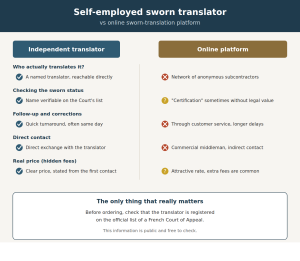
With a self-employed translator, you know exactly who you’re entrusting your birth certificate or diploma to: a named individual, registered on a Court of Appeal’s list, whom you can contact directly with a question or an urgent request. On some online platforms, the order goes through a commercial intermediary, who then subcontracts the work to a network of translators whose name you’ll never know. Nothing illegal about that in itself, but this opacity makes it harder to sort out a doubt over a name transcription, a date, or a specific note.
The very real risk of a fake “certification”
This is the main pitfall to watch for: some sites use the vocabulary of “sworn” translation without the resulting document actually carrying that legal value. A document labelled “certified” by a platform isn’t necessarily translated by a translator registered with a French Court of Appeal. Clients sometimes only find out at the prefecture counter, when their file is rejected — after having already paid and waited. Before placing an order, a simple habit is worth adopting: ask for the translator’s name and check their registration on the relevant Court of Appeal’s website, which is public and free to consult.
Follow-up support, often overlooked
A mistranscribed name, a mistransliterated date, a missing attachment: these things happen, even with a serious professional. The difference shows up in the follow-up. A self-employed translator can usually pick the file back up the same day. On a platform, a correction means going back through customer service, sometimes based abroad, with longer response times, and the original translator isn’t always the one who handles the follow-up request.
The price isn’t always what it looks like
Platforms often display attractive rates at first glance, but extra fees (postal delivery, urgency, additional copies) can bring the final bill close to that of a self-employed professional — without the same guarantee of direct contact.
In short
A sworn-translation website isn’t necessarily a scam, but it does involve a chain of intermediaries the client doesn’t control. A self-employed sworn translator, by contrast, offers a direct, transparent and verifiable relationship. For a document tied to an important administrative process — naturalization, residence permit, diploma equivalence — that transparency has real value. Feel free to contact me directly to verify my registration or ask any questions before placing your order.